- Juniorstocks.com
- Posts
- What happens when defense metals take a one-way trip?
What happens when defense metals take a one-way trip?
You're receiving this newsletter as a subscriber to JuniorStocks.com. Join the conversation on our socials below.

Editorial Team
March 24, 2026
In partnership with

We Can't Recycle Missiles: The One-Way Trip of Defense Metals
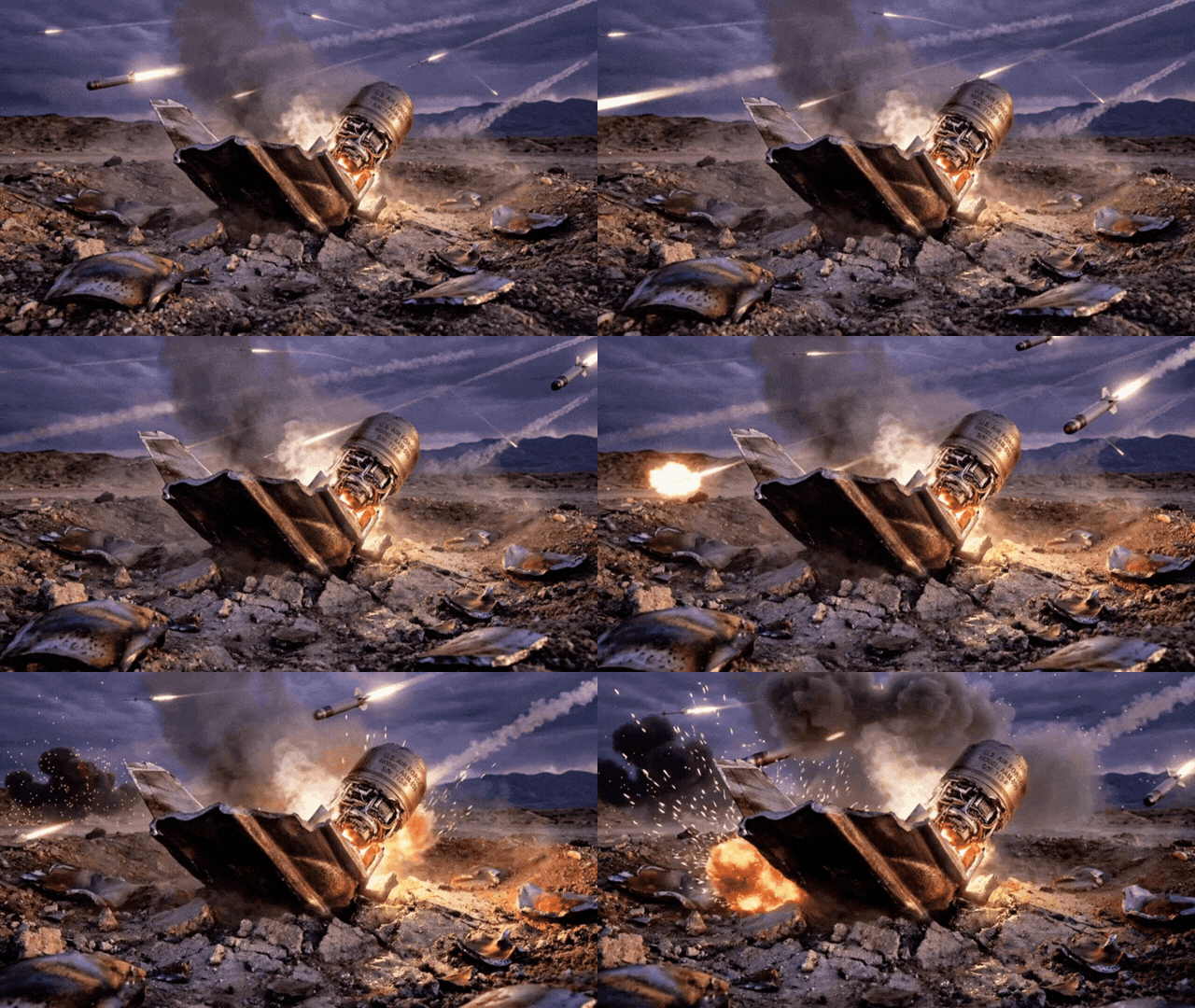
You can recycle a lot of things. A bunker-buster isn’t one of them.
Every time a modern missile detonates, the critical heavy metals inside are gone forever. It is a one-way trip that is rapidly burning through U.S. stockpiles and exposing a terrifying equation of "mineral math" the West is dangerously close to failing.
We just watched this exact panic rip through the antimony market. When foreign export controls choked the defense sector, the U.S. government frantically backed developers like Perpetua Resources (NASDAQ: PPTA), even as legacy refiners like United States Antimony Corporation (NYSE: UAMY) publicly threw shade, questioning if those new projects could actually deliver military-spec material.
Now, that same supply shockwave has hit tungsten.
With prices going parabolic and adversarial exports shrinking, the Pentagon is sprinting for domestic autonomy. They recently funneled grant money to Guardian Metal Resources (OTCQX: GMTLF) to fast-track the massive Pilot Mountain project in Nevada.
Geopolitics can shift overnight, but geology takes years. Right now, the defense sector is essentially trying to weave a parachute while already in freefall.
Gold Prices Stabilize Following Historic 15% Drop Amid Iran Conflict

It is the ultimate market irony: when a massive geopolitical crisis hits, the asset you expect to soar is often the first to be sold.
Gold has finally steadied after a brutal 15%, nine-day selloff triggered by the Middle East conflict. While it seems counterintuitive for the world's premier safe-haven asset to crater during a war, the mechanics behind it are pure, unapologetic capitalism. Surging energy prices from the Strait of Hormuz closure sparked inflation fears, guaranteeing higher interest rates and triggering widespread margin calls.
When investors need cash to cover underperforming bonds and equities, they liquidate their winners. Gold was simply acting as the highly liquid piggy bank it was designed to be. It is a harsh reminder that in the short term, positioning and liquidity always trump sentiment.
Building a $340 Billion Monopoly: Inside China’s Critical Mineral Masterplan

If the global energy transition is a high-stakes game of Monopoly, Beijing isn’t just buying up Boardwalk, they own the board and the bank.
While Western policymakers debate green subsidies and domestic permitting, China has quietly executed a $340 billion masterclass in resource dominance. According to Climate Energy Finance, Beijing has deployed $120 billion into overseas mining since 2023, strategically fusing it with a $220 billion massive push into downstream EV and battery manufacturing.
This new era of "green energy statecraft" goes beyond extraction. By partnering with host nations from the Democratic Republic of Congo to Indonesia to build local processing hubs, China has locked down roughly 90% of global rare earth refining and over 90% of the world's battery materials.
The squeeze on Western private enterprise is real. Industry heavyweights like Albemarle Corporation (NYSE: ALB) are navigating margin-crushing Chinese capacity, while strategic producers like Lynas Rare Earths Limited (ASX: LYC) are scrambling to forge government-backed alternative supply chains. Replicating Beijing's ruthless execution and state-backed financing will take the West decades.
Three to Five Years: The True Cost of Global Energy Supply Chain Ruptures

Wall Street loves a quick fix, but repairing the global energy supply chain is a three-to-five-year hangover.
Catching the Opening Bid interview on Yahoo Finance with Brian Sozzi revealed a fascinating market divide. On one hand, Tom Sosnoff is treating Crude Oil (CL=F) volatility as a premium-selling playground, actively fading bullish targets from Goldman Sachs (NYSE: GS). On the other, Lee Munson, CFA delivered a brutal macroeconomic reality check: damaged physical infrastructure takes years to rebuild, not weeks.
The S&P 500 might be riding high on geopolitical FOMO today, but structurally higher oil will inevitably crush corporate earnings. A delayed reaction doesn't mean a canceled one.
When it all clicks.

Why does business news feel like it’s written for people who already get it?
Morning Brew changes that.
It’s a free newsletter that breaks down what’s going on in business, finance, and tech — clearly, quickly, and with enough personality to keep things interesting. The result? You don’t just skim headlines. You actually understand what’s going on.
Try it yourself and join over 4 million professionals reading daily.
We want your feedback on this week’s market insights! How’d we perform? 📈📉Let us know where we stand! 🚀 |